New Taxi Leaks

Sunday, 3 March 2024

๐“๐ก๐ž ๐๐ซ๐ข๐๐ž๐ฌ ๐ˆ๐ง ๐“๐ก๐ž ๐๐š๐ญ๐ก ๐’๐ž๐ซ๐ข๐š๐ฅ ๐Š๐ข๐ฅ๐ฅ๐ž๐ซ.

George Joseph Smith was a notorious English serial killer and bigamist who terrorized the early 20th century with his heinous crimes. His case, known as the Brides in the Bath Murders, shocked the nation and captivated the media. Smith's manipulation and deceitful ways led to the deaths of three innocent women, making him a face of evil that is remembered in history.

Smith was born on January 11, 1872, in London, England, to a working-class family. Growing up, there were no indications of the dark path he would eventually take. He married his first wife in 1898, but it wasn't long before his true nature emerged. Smith was a charming man who used his charisma to deceive women into marrying him for financial gain. He would marry multiple women simultaneously, promising them a life of luxury before ultimately drugging and drowning them in their baths to claim their life insurance policies.

Smith's modus operandi was chillingly calculated. He would gain the trust of his victims, convince them to marry him, and then set about draining their finances before murdering them. The Brides in the Bath Murders refers to the deaths of Bessie Mundy, Alice Burnham, and Margaret Lofty, all of whom fell prey to Smith's manipulative ways. His crimes were brought to light in 1915 when he was arrested, tried, and convicted of their murders.

The case of George Joseph Smith was a landmark in forensic pathology and detection. The similarities between the murders of the three women were crucial in proving Smith's guilt. It was one of the first instances where connected crimes were used to establish a pattern of deliberation, ultimately leading to his conviction. The case also highlighted the importance of thorough investigations and the need for more stringent measures to prevent similar atrocities from happening in the future.

The impact of George Joseph Smith's crimes reverberated throughout society, sparking discussions on the dangers of manipulation and the need for stricter regulations on marriage and insurance policies. The media coverage of the case brought attention to the issue of domestic violence and the vulnerability of women in society. Smith became a symbol of evil, a cautionary tale of the dangers of falling prey to charming but deceitful individuals.

Despite the negative implications of Smith's actions, his case has also had positive repercussions in the field of criminal justice. The techniques used in his prosecution have paved the way for more effective methods of investigating and prosecuting serial offenders. The case serves as a reminder of the importance of thorough investigations and the value of forensic evidence in solving crimes.

Executed by hanging in Maidstone prison on 13th of August 1925, George Joseph Smith will forever be remembered as a face of evil for his heinous crimes. His manipulation and deceit led to the deaths of three innocent women, leaving a trail of devastation in his wake. The Brides in the Bath Murders case was a turning point in the history of forensic pathology and detection, highlighting the need for more stringent measures to prevent similar crimes from occurring. Smith's legacy serves as a cautionary tale of the dangers of falling prey to charming but manipulative individuals and the importance of thorough investigations in bringing criminals to justice.


Image colourised by Electric Colour.

Friday, 1 March 2024

WHERE THE DICKENS DID HE GET HIS INSPIRATION FROM?

Fagin :
Dickens if thought to have drawn inspiration for the character of Fagin, from Isaac Solomon. Known as Ikey, he was a notorious Jewish criminal who operated in London during the 19th century. He was a master thief, fence, and receiver of stolen goods, and his criminal activities made him a feared and respected figure in the underworld of the time.


Born in London in 1785, Solomon grew up in poverty and turned to a life of crime at a young age. He quickly made a name for himself as a skilled thief and began to build a criminal empire that spanned across the city. He was known for his cunning and ability to outsmart the police and was able to avoid capture for many years.

Solomon was also known for his connections to other criminals and his ability to fence stolen goods. He operated a successful pawn shop on Saffron Hill in London, where he would buy and sell stolen property at a considerable profit. This allowed him to amass a considerable fortune and cement his reputation as one of the most powerful criminals in the city.

Despite his criminal activities, Solomon was also known for his generosity towards those in need. He often provided financial assistance to struggling members of the Jewish community and was seen as a Robin Hood-like figure by many.

However, Solomon's criminal empire eventually came crashing down in 1830 when he was arrested and convicted of receiving stolen goods. He was sentenced to transportation to Australia, where he spent the rest of his life.

Ikey Solomon's life story is a fascinating tale of crime, cunning, and charisma. He was a larger-than-life figure who managed to rise from poverty to become one of the most powerful criminals in London. While his criminal activities were certainly illegal and unethical, his ability to outsmart the authorities and evade capture for so long is a testament to his intelligence and cunning.

Though his criminal activities ultimately led to his downfall, his reputation as a master thief and receiver of stolen goods has ensured that he will be remembered as one of the most notorious figures of his time.

Bill Sykes : 
A well-known antagonist in Charles Dickens' classic novel, Oliver Twist. He is portrayed as a violent, abusive criminal who is involved in various nefarious activities, including robbery and murder. Many readers have wondered if Bill Sykes was based on a real-life character, as his actions and behaviour seem so vivid and detailed.


While there is no definitive proof that Sykes was based on a specific individual, it is widely believed that Dickens drew inspiration from the criminals and villains he encountered in the seedy underbelly of Victorian London. During his time as a journalist, Dickens frequently visited prisons and met with convicts, giving him insight into the world of crime and poverty.

One possible inspiration for Bill Sykes could have been the notorious criminal Bill Sikes, who was active in London during the early 19th century. Sikes was involved in a number of criminal activities, including theft and violence, and his name became synonymous with fear and cruelty. It is likely that Dickens heard of Sikes's exploits and incorporated them into his novel, creating a character who embodies the darkest aspects of human nature.


Another possible influence on Bill Sykes was the real-life case of Burke and Hare, two infamous serial killers who murdered their victims in order to sell their bodies to medical schools for dissection. The callousness and brutality displayed by these men may have served as a basis for Dickens's portrayal of Sykes as a heartless and remorseless criminal.

Additionally, Dickens may have drawn inspiration from his own experiences and observations of the poverty and desperation that plagued London during his time. The stark divide between the wealthy and the impoverished, as well as the harsh conditions faced by the lower classes, likely informed Dickens's depiction of characters like Bill Sykes who were driven to crime out of desperation and a lack of opportunities.

The Artful Dodger :
The Artful Dodger (Jack Dawkins) however, is an entirely fictional from Dickens 'Oliver Twist', as are Oliver, Nancy and the rest of the novels characters. 
While there is no concrete evidence to suggest that Fagin or Bill Sykes were directly based on real-life characters, it is clear that Dickens drew inspiration from the criminal underworld and societal injustices of his time to create characters who are both horrifying and compelling. 
By weaving together elements of fact and fiction, Dickens crafted timeless villains whose legacy continues to captivate readers to this day.


In conclusion :
If like me, you enjoyed the films and musical productions of this classic, but have never read the book itself, you'd be amazed at the amount of the plot that’s been left out. Pivital characters completely erased from the films, plays, musicals. 

But don’t worry, I’m not going to post any spoilers…I would however, strongly advise reading the novel. 
In my opinion, the best part of the story has been completely overlook, possibly because of the time it would take to film/show the whole story in its entirety.

Wednesday, 21 February 2024

๐Ÿ๐Ÿ๐ฌ๐ญ ๐จ๐Ÿ ๐…๐ž๐›๐ซ๐ฎ๐š๐ซ๐ฒ, ๐ฆ๐š๐ซ๐ค๐ฌ ๐ญ๐ก๐ž ๐ข๐ง๐ญ๐ซ๐จ๐๐ฎ๐œ๐ญ๐ข๐จ๐ง ๐จ๐Ÿ ๐ญ๐ก๐ž ๐†๐ซ๐ž๐ ๐จ๐ซ๐ข๐š๐ง ๐œ๐š๐ฅ๐ž๐ง๐๐š๐ซ.

Named after Pope Gregory XIII, who introduced it in 1582, the Gregorian calendar replaced the Julian calendar, which had been the most used calendar in Europe until this point.

In 45 BC, Julius Caesar ordered a calendar consisting of twelve months based on a solar year.

๐’๐จ, ๐ฐ๐ก๐ฒ ๐ญ๐ก๐ž ๐œ๐ก๐š๐ง๐ ๐ž?

In 1582, it was discovered that the Julian Calendar was out by 10 days in regard to the tropical year and because the date of Easter was tied to the Spring Equinox, the Roman Catholic Church considered the seasonal drift in the date of Easter undesirable.

So in October of 1582, 10 days were removed from that month and the day after the 4th became the 15th. This was designed to bring the vernal equinox in line with the tropical year. 

The introduction of the calendar wasn't welcomed by everyone, for instance in England mobs protested, fearing they would lose wages for the missing days, plus they would lose 10 days of their life.

Their cry was “Give us back our 11 days!”—referring to the 10 days dropped plus the day of the calendar change itself.

The Julian calendar is still used as a religious calendar in parts of the Eastern Orthodox Church, as well as by the Amazigh people in Morocco, Libya, Algeria, and Tunisia (also known as the Berbers).

Today there is a disparity of 13 days from the original Julian calendar which will increase to 14 days by 2100. 

As they say….what a difference a day makes .

Friday, 6 October 2023

THE EASTCASTLE STREET MAIL VAN ROBBERY

The van was on a diversion from its usual route due to roadworks taking place in Oxford Street. As it passed along Eastcastle Street a car pulled out in front of the mail van and another vehicle pulled up behind it blocking its movement. The driver, guard and sorter were all forcibly removed from the van which was driven away and abandoned in nearby Augustus Street.


A total of £236, 748 10s (worth £7.3 million today) was stolen. As with the Great Train Robbery, there was initially suspected that a member of Post Office staff may have been involved.


Staff on board the mail van at the time of the robbery came under particular scrutiny. There were a few factors which increased these suspicions. The van was fitted with an ambush alarm, but this was not used during the raid. When the van was recovered it was discovered that the alarm was deactivated.


Another incriminating factor was that proper processes for handling the keys had not been followed. The driver should have handed them to the guard for safekeeping but had instead left them on the seat of the van. These oversights, together with the fact that the driver did not sustain serious injuries in the attack, all raised questions.


In July 1952 Robert Kingshott (who had previously been dismissed from the Post Office for theft) and Edward Noble went on trial for receiving money stolen in the raid. After the extensive debate, the jury found them both not guilty.


The mastermind  believed to be behind the raid was London gangster Billy Hill and the robbers included George "Taters" Chatham and Terry "Lucky Tel" Hogan. Although no one was ever arrested for the crime,  it still remains unsolved.


Tuesday, 6 December 2022

๐ŸŸฉ ๐“๐ก๐ž ๐๐š๐ฅ๐œ๐จ๐ฆ๐›๐ž ๐’๐ญ๐ซ๐ž๐ž๐ญ ๐ฌ๐ข๐ž๐ ๐ž ๐Ÿ”๐ญ๐ก ๐ญ๐จ ๐ญ๐ก๐ž ๐Ÿ๐Ÿ๐ญ๐ก ๐ƒ๐ž๐œ๐ž๐ฆ๐›๐ž๐ซ ๐Ÿ๐Ÿ—๐Ÿ•๐Ÿ“:

This was an incident involving members of the Provisional Irish Republican Army and London's Metropolitan Police which lasted lasting 12 days, from 6 to 12 December 1975. 

The siege ended with the surrender of the four IRA members and the release of their two hostages. The events were televised and watched by millions.

In 1974 and 1975, London was subjected to an intense 14-month campaign of gun and bomb attacks by the Provisional IRA. In one incident the Guinness Book of Records co-founder and conservative political activist Ross McWhirter was assassinated. He had offered a £50,000 reward to anyone willing to inform the security forces of IRA activity.

The four members of what became known as the "Balcombe Street gang", Joe O'Connell, Edward Butler, Harry Duggan and Hugh Doherty, were part of a six-man IRA Active Service Unit (ASU) that also included Brendan Dowd and Liam Quinn. Quinn had recently shot dead police constable Stephen Tibble in London after fleeing from police officers. The flat he was seen fleeing from was discovered to be a bomb factory used by the unit.

The Balcombe Street siege started after a chase through London, as the Metropolitan Police pursued Doherty, O'Connell, Butler and Duggan through the streets after they had fired gunshots through the window of Scott's restaurant in Mount Street, Mayfair. 

They had thrown a bomb through the restaurant window a few weeks before on 12 November 1975, killing John Batey and injuring 15 others. 

The Met's Bomb Squad had detected a pattern of behaviour in the ASU, determining that they had a habit of attacking again some of the sites they had previously attacked. In a scheme devised by a young detective sergeant, the Met flooded the streets of London with plainclothes officers on the lookout for the ASU, in what was known as Operation Combo. The four IRA men were spotted as they slowed to a halt outside Scott's and fired from their stolen car.

Inspector John Purnell and Sergeant Phil McVeigh, on duty as part of the dragnet operation, picked up the radio call from the team in Mount Street as the stolen Ford Cortina approached their position. 

With no means of transport readily available, the two unarmed officers flagged down a taxi cab and tailed the men for several miles through London, until the IRA men abandoned their vehicle. 

Purnell and McVeigh, unarmed, continued the pursuit on foot despite handgun fire from the gang. Other officers joined the chase, with the four IRA men running into a block of council flats in Balcombe Street, adjacent to Marylebone station, triggering the six-day standoff. Purnell was subsequently awarded the George Medal for his bravery. Several other police officers were also decorated.

The Balcombe Street Gang had carried out the majority of their attacks in London, Surrey, Hampshire and Wiltshire. 

Between October 1974 and December 1975 they carried out approximately 40 bomb and gun attacks in and around London, sometimes attacking the same targets twice. 

On 27 January 1975 they placed seven time bombs in London.

The siege

The four men went to 22b Balcombe Street in Marylebone, taking its two residents, middle-aged married couple John and Sheila Matthews, hostage in their front room. The men declared that they were members of the IRA and demanded a plane to fly both them and their hostages to Ireland. Scotland Yard refused, creating a six-day standoff between the men and the police. Peter Imbert, later Commissioner of the Metropolitan Police, was the chief police negotiator. Max Vernon, who was later chief negotiator of the Iranian Embassy siege was another of the police negotiators.

The men surrendered after several days of intense negotiations between Metropolitan Police Bomb Squad officers, Detective Superintendent Peter Imbert and Detective Chief Superintendent Jim Nevill, and the unit's leader Joe O’Connell, who went by the name of "Tom". The other members of the gang were named "Mick" and "Paddy", thereby avoiding revealing to the negotiators precisely how many of them were in the living room of the flat. 

The resolution of the siege was a result of the combined psychological pressure exerted on the gang by Imbert and the deprivation tactics used on the four men. The officers also used carefully crafted misinformation, through the BBC Radio news—the police knew the gang had a radio—to further destabilise the gang into surrender. 

A news broadcast stated that the Special Air Service (SAS) were going to be sent in to storm the building and release the hostages. This seemed to deter the gang and they eventually gave themselves up to the police.

Monday, 31 October 2022

๐Œ๐š๐ซ๐ ๐จ๐ซ๐ข๐ž ๐Œ๐œ๐‚๐š๐ฅ๐ฅ, “๐‹๐ข๐ฏ๐ž๐ ๐Ž๐ง๐œ๐ž, ๐๐ฎ๐ซ๐ข๐ž๐ ๐“๐ฐ๐ข๐œ๐ž”.

Tucked away behind residential streets in the heart of Lurgan lies the centuries old Shankill Graveyard.


If you dare to creep through the wrought iron gates and move amongst the sinking tombstones, you're sure to find a few spine-chilling tales.

Local historian, Jim Conway, is the authority on the horrifying stories that haunt the 17th century site.

Margorie McCall is the first grave he leads me to, the woman who live once and was buried twice.

In 1695, Margorie caught a fever and, believed to be dead, her family held a wake and promptly buried her.

Soon after she was laid to rest, grave robbers, who regularly ransacked newly buried coffins, dug her up and attempted to steal a valuable ring she was still wearing.

Unable to remove the ring from her finger, the robbers decided to cut the finger off.

But as they began their gruesome task, the lady awoke and, as Jim puts it, "she scared the devil out of the grave robbers, who soon skedaddled".

Margorie got out of her grave, dusted herself off and went home, but when she got there her husband nearly died of shock.

Jim says the story goes that on hearing his wife's knock at the door, Mr McCall said to his children: "If I hadn't buried your mother, I would swear that was her knock."

When he opened the door he fainted and, according to Jim, his hair went white overnight.

Margorie lived on and even had another child after her ordeal, before being buried once more in what proved to be her final resting place.


Wednesday, 2 February 2022

James II, obeyed his brother's (Charles II) deathbed wish, "Let not poor Nelly starve" .


London, Hereford and Oxford have all laid claim to Pepys’ ‘pretty witty Nell’ – he also called her ‘a bold merry slut’ -- but she was probably a native Londoner, born close to the scene of her future triumphs, in a squalid back alley called Coal Yard, off the northern end of Drury Lane. The date of her birth comes from her horoscope, which was drawn up years afterwards. A modern reading of it would endow her with sex appeal, charm, self-confidence, gregariousness and a ready wit – all of which the grown Nell amply demonstrated, along with a delectable figure, excellent legs and fashionably tiny feet.

Very little is known about Nell’s life. She grew up carrying drinks to customers in a brothel, which may have been owned by her brandy-soaked mother, who toppled drunkenly into the river one day in 1679 and drowned. Nell’s father was apparently a broken-down Welsh army officer, who died in prison for debt. There was an elder sister, Rose, who married a highwayman and spent time in prison for theft. At thirteen, Nell got a job as an orange girl at the newly opened King’s Theatre in Drury Lane (forerunner of the Theatre Royal), where she developed her gift for quickfire repartee.

For a spirited slum girl with looks, intelligence and ambition, it was a promising start. Nell quickly graduated from the pit to the stage, making her first appearance when she was fourteen and it was still a novelty for female parts to be played by women. She was soon a popular favourite in light comedy, starring opposite the actor Charles Hart, who was her lover, and scoring a triumph in Dryden’s Secret Love in 1667. She soared swiftly to the top of the social ladder. After an affair with the rakish Lord Buckhurst, she fell into the arms of Charles II himself. With characteristic wit she called him her Charles III, as both Hart and Buckhurst were named Charles too.

She was still only seventeen, to the king’s thirty-seven, and she continued her successful stage career until after the birth of her first son, yet another Charles, and the future Duke of St Albans, in 1670. 

The king gave her a grand house at 79, Pall Mall, where John Evelyn saw her one day leaning over her garden wall chaffing her royal lover, who was standing below in St James’s Park. Nell had a magnificent silver bed in the house, adorned with the king’s head and figures of cupids and slaves, as well as crowns and eagles. Other treasures included a warming pan inscribed ‘Fear God and serve the King’.

Nell’s sauciness, cheerfulness, lustiness, straightforward good nature and lack of affectation evidently came as a relief to Charles, as did her lack of any serious interest in politics. Unlike many of his other mistresses, Nell seems to have been completely faithful to him and when he lay dying, in 1685, the King told his brother and heir, the future James II, not to let poor Nelly starve. Starve she did not, but she outlived her third Charles by only two years and died in her Pall Mall residence in 1687, only thirty-seven years old. She was buried in St Martin’s-in-the- Fields in the same grave as her mother and at her funeral she drew a large audience for the last time. The sermon was preached by a future Archbishop of Canterbury, Thomas Tenison, who praised her kindness to the poor and found much good to say of her.

Thursday, 27 January 2022

Gunpowder Plot, January 27th 1606


January 27th 1606: The one-day trial of Guy Fawkes and his fellow conspirators at Westminster Hall. It opened with the indictment that the plotters:

“traitorously amongst themselves didst conspire, conclude and agree, with gunpouder, as it were with one blast, suddenly, villainously and barbarously to blowe up and tear in pieces our said sovereign Lord the King.”

They were charged with treason for plotting & attempting to blow up the Houses of Parliament on November 5th 1605. 

The sentencing powers available to the judges were somewhat more robust in those days - Fawkes & co were hanged, drawn and quartered in Old Palace Yard a few days later.

Source :Maybe it's because I'm a Londoner, Ian A Biddell.

Saturday, 8 January 2022

THE 1940s LONDON BLACKOUT RIPPER

Just fifty-four years after the notorious ‘Jack the Ripper’ waged his merciless trade in cutting up to five women on the streets of London, another spree killer appeared in the shadows. This monster attacked women over six days during a cold February 1942. He was eventually caught and identified as 27-year-old Gordon Frederick Cummins. 

From the start of World War II, London’s streets and buildings were kept dark as a precaution against aerial bombing by the Luftwaffe. Street lamps were not lit, the windows of houses, shops, offices and factories were blacked out. 

During 57 successive days of aerial bombing, the blackout’s strict rules allowed the psychopathic Cummins to carry out his orgy of obscene violence against women who were going about their business. As the bombs fell, in six days in February 1942, Cummins murdered four women and attacked two others. 

Three of his victims were mutilated after death. The newspapers dubbed him ‘The Blackout Ripper.'

On Sunday, February 9, teacher Evelyn Hamilton’s body was discovered in an air raid shelter in Montagu Place, Marylebone. Someone had strangled her. There were no signs of sexual assault.

On Monday, February 10, prostitute Evelyn Oatley was found dead. Two gas meter readers discovered her as they were let into her Soho flat in Wardour Street. The butchered body of 35-year-old Evelyn Oatley was a horrifying sight. This time, the victim was so viciously slashed that her injuries even shocked the investigating officers. While she was still alive, Cummins abused her private parts with curling tongs. Her throat had been cut; she was naked and her body had been sexually mutilated with a tin opener. The tin opener was found close by, covered in Oatley’s blood. It provided vital fingerprints in the investigation. An examination of her body also yielded the fact the killer was left-handed.

The next day, Tuesday, February 11, another prostitute, Margaret Florence Lowe, was murdered in her Gosfield Street flat. She had been strangled with a silk stocking and mutilated with both a knife and razor blade. Her body was not discovered until three days later. 

After examining this victim’s body, the pathologist stated the murderer was a savage sexual maniac. The similarities between the killings and mutilations convinced the police that the same killer was responsible.

On Wednesday, February 12, Mrs Doris Jouannet was murdered in her two-room ground-floor flat in Paddington she shared with her husband. Jouannet was in the habit of picking up servicemen in Leicester Square. She had been strangled and her naked body had been sexually mutilated. The abuse was so severe and revolting that the pathologist examining the victim described Gordon Cummins as ‘a savage sexual maniac.’

On Friday, February 14, near Piccadilly Circus, Greta Hayward was attacked. A delivery boy on his rounds interrupted her assailant and Hayward was able to escape. Cummins fled - but left his RAF-issue gas mask behind at the scene.

The number on the mask was easily traced and linked to Cummins, but even as the police were working on the lead, he struck again. A prostitute called Catherine Mulcahy was attacked in her flat near Paddington Rail Station. She resisted Cummins so effectively that he abandoned his murderous intentions and gave her an extra £5 and left quickly.

On February 16, the police arrested Cummins in the St. John’s Wood district. His fingerprints matched those on the bloody tin opener and a search of his quarters turned up several items that belonged to his victims.

Cummins went to trial for his murder spree on April 27; during this time, he wrote a letter to his wife that seemed to imply he might’ve blacked out whenever he started killing. Nevertheless, it took the jury 35 minutes to find him guilty, and he was sentenced to death by hanging. Cummins was executed at Wandsworth prison on June 25, ironically during an air raid. After his execution, a fifth body was discovered and attributed to him. The woman was identified as a Mrs Church and was thought to have been killed in October 1941.

Sunday, 28 November 2021

Electric Delivery Vehicles: Is History About To Repeat Itself ???


In 1939 Harrods introduced a fleet of 50 electric delivery vans which had a range of about 60 miles between charges and could do 18 mph 


In 1951, dairies around London developed a cheaper version of the Van (the electric milk float, 3 wheels, chain driven) which had a smaller battery and a range of 16 miles. 


By 1967, the uk had more electric milk floats than the rest of the world combined.


My uncle Patsy drove a Harrods electric van in the early 60s and he would let me sit on his lap and drive it up and down Kilburn Park Road.


Many companies today are now looking to reintroduce the electric delivery vans based on the design of the old milk floats… which could be produced much cheaper than the modem electric hybrid commercial versions). As we’ve seen in the past from Harrods, they make fantastic online delivery vehicles which are completely exempt from the ULEZ charge (but knowing Sadiq Khan as we do, that could all change).


Some old restored milf floats can still be found around the UK, used as coffee/tea/flower stalls in market areas.


The last Harrods delivery van was taken out of service in 1970 and presented to a transport museum and was still in perfect working order when decommissioned. 


The TXe London’s most expensive Taxi ever produced, has a range of about 50 miles in fully electric mode, unless passenger wants heater or AC on! 


Not really leaps and bounds in technology, in 70 odd years!!!


Monday, 22 November 2021

Something different the children can do…build your own oxygen production unit ๐Ÿ˜œ

Planting pine trees can provides shade, windbreaks and screening in the environment.

They can also offer us some less obvious benefits such as the soothing sounds of wind through the pine branches and aromatic fragrances from leaves and sap.  I personally love pine trees because they always remind me of Christmas time.

There are about 114 species of pines, native mostly to the Northern Hemisphere. They do grow throughout the world though mainly as ornamentals.

I came across a post on Facebook today that I thought you might like too.

It shows how we can grow our own pines in only 5 simple steps.

1. Go to the woods. Find a few pinecones.

๐ŸŒฒ๐ŸŒฒ๐ŸŒฒ

2. Put the pinecone in a pot with compost- so that most of it stands out.

3. Every day, just give it a small amount of water, as excess water will make the pinecone rot.

4. After some time, a tiny tree(trees) will appear.

5. Congratulations - the new trees will start oxygen production and you will have a piece of forest in your own home

๐Ÿ๐Ÿ‚๐Ÿƒ.

You're doing something for nature, and you'll see what nature does for you ❤️


Tuesday, 16 November 2021

One More For The Road, Highwayman Jack Sheppard

November 16th 1724:  Jack Sheppard, Stepney born highwayman & housebreaker, was hanged at Tyburn in front of 200,000 spectators. Born into a poor family, he was apprenticed as a carpenter but took to theft and burglary. 

He was arrested and imprisoned five times in 1724 but escaped four times from prison, making him a notorious public figure, and wildly popular with the poorer classes. 

By the time Sheppard's execution cart arrived at Tyburn, Jack was almost insensible from the vast quantity of grog and ale given to him at several inns and taverns as their traditional sending-off gift of 'One More For The Road', by some accounts, Sheppard had to be supported for the noose to be placed.

Sheppard's life story was an inspiration for William Hogarth's 1747 series of 12 engravings, titled 'Industry and Idleness', which shows the descent of an apprentice into crime and eventually to the gallows.

The Amazing Escapes of Jack Sheppard

Jack Sheppard was the 18th century’s most notorious robber and thief. His spectacular escapes from various prisons, including two from Newgate, made him the most glamorous rogue in London in the weeks before his dramatic execution.

Jack Sheppard (4 March 1702 – 16 November 1724) was born into a poor family in Spitalfields in London, an area notorious for highwaymen, villains and prostitutes in the early 18th century. He was apprenticed as a carpenter and by 1722, after 5 years of apprenticeship, he was already an accomplished craftsman, with less than a year of his training left.

Now 20 years old, he was a small man, 5’4″ tall and slightly built. His quick smile, charm and personality apparently made him popular in the taverns of Drury Lane, where he fell in with bad company and took up with a prostitute called Elizabeth Lyon, also known as ‘Edgworth Bess’.

He threw himself wholeheartedly into this shady underworld of drinking and whoring. Inevitably, his career as a carpenter suffered, and Sheppard took to stealing in order to boost his legitimate income. His first recorded crime was for petty shoplifting in spring 1723.

Jack Sheppards first escape CCIt was not long before he met and fell in with local villain Joseph Blake, known as ‘Blueskin’. His crimes escalated. He was arrested and imprisoned five times between 1723 and 1724 but escaped four times, making him notorious yet extremely popular especially amongst the poor.

His First Escape, 1723.

Sent to St Anne’s Roundhouse for pick-pocketing, he was visited there by Bess Lyon who was recognised and also arrested. They were sent together to New Prison in Clerkenwell and were locked in a cell known as The Newgate Ward. The next morning Sheppard filed off his fetters, made a hole in the wall and removed an iron bar and a wooden bar from the window. Tying sheets and blankets together, the pair lowered themselves to the ground, Bess going first. They then climbed over a 22-foot-high wall to make good their escape, quite a feat considering Jack was not a tall man and Bess was quite a large, buxom woman.

His Second Escape, 30th August 1724.

In 1724, having been convicted of burglary, Jack Sheppard found himself under sentence of death. In Newgate in those days there was a hatch with large iron spikes opening into a dark passage,

which led to the condemned cell. Sheppard filed away one of the spikes so that it would easily break off. In the evening two visitors, Bess Lyon and another prostitute, Moll Maggot, came to see him. They distracted the guard whilst he removed the spike, pushed his head and shoulders through the space and with the help of the two women, made his escape. This time his slight frame was to his advantage.

He was however, not free for long.

His Last and Most Famous Escape, 15th October 1724

Jack Sheppards third escape CCJack Sheppard made his most famous escape, again from Newgate Prison, between the hours of 4pm and 1am on 15th October. He succeeded in slipping off his handcuffs and with a crooked nail, picked the padlock securing his chain to the floor. Forcing several locks, he scaled a wall and reached the roof of the prison. Returning to his cell for a blanket, he then used it to slide down the roof and onto a neighbouring roof. Climbing into the house, he escaped through the front door, still wearing his leg irons.

He persuaded a passing shoemaker to remove the leg irons but was later apprehended, less than two weeks later, too drunk to resist arrest.

Daniel Defoe, the author of Robinson Crusoe, was so entranced by Jack Sheppard’s daring escapes that he ghostwrote his autobiography, A Narrative of all the Robberies, Escapes etc. of John Sheppard, in 1724.

Sheppard was convicted and sentenced to be hanged at Tyburn, ending his short criminal career. He was such a popular rebel hero that the route to his execution was lined by weeping women dressed in white and throwing flowers.

However Sheppard had planned one last great escape – from the gallows.

In a scheme involving Daniel Defoe and Appleby, his publisher, it was planned that they would retrieve the body after the requisite 15 minutes on the gallows and try to revive him, as in rare cases it was possible to survive a hanging. Unfortunately the crowd were unaware of this plan. They surged forward and pulled on his legs to ensure their hero a swift and less painful death. He was buried that night in the graveyard of St Martin-in-the-Fields.

Sheppard was famous for his daring escapes from prison. So much so, popular plays were written and performed after his death. The character of Macheath in John Gay’s The Beggar’s Opera (1728) was based on Sheppard. Then in 1840 William Harrison Ainsworth wrote a novel called Jack Sheppard. This novel was so popular that the authorities, in case people should be incited to crime, refused to license any plays in London with “Jack Sheppard” in the title for a further forty years.


Saturday, 2 October 2021

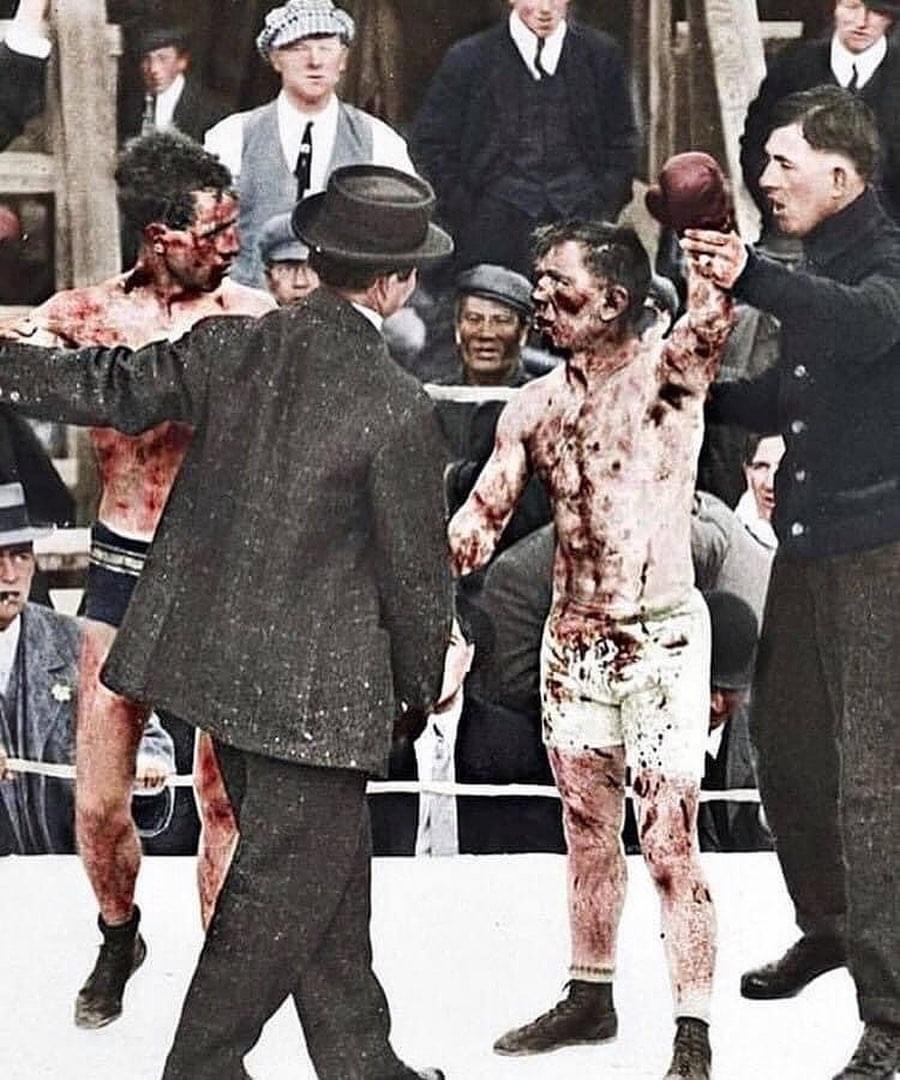
The Longest Boxing Match in History 7 hours and 19 minutes for $2,500 in 1893

This is what two boxers looked like after a fight that lasted 110 rounds! 

Yes, you read it correctly, 110 rounds (7h 19m of fighting). 

It was April 6, 1893, Andy Browen vs. Jack Burke. This is of course the longest boxing fight in history!

History has definitely presented us with some incredible fights, be it in sporting events or even war, and from this, we are able to admire how amazing the human race really is. 

However, there are some events in which some determine people keep on fighting even after they have collapsed more than ten times. 

This motivation or desire to win is usually created by a reason or a person to fight for, however, this case was a bit different.

April the 6th, 1893, marks a date that has entered not only in history books but also in the Guinness World Records book as the day the longest boxing match took place. 

This match was between Andy Bowen and Jack Burke at the Olympic Club in New Orleans (Louisiana, USA). 

This was the final fight in a tournament to win the title of Lightweight Champion of the South.

More attractive to all the contenders, was the large cash prize of $2,500. Today, that may not seem very much for a boxing championship, however, taking inflation into consideration, today we would be looking at $51,642, and back in 1893, this was a very big amount of cash. 

To give you an even better perspective, the average price of a medium-size house at the time in America was around $3,000.

Determination from both contenders

The fight started at exactly 9 PM that day and lasted until the next day at 4 AM. 

Both fighters were described as very energetic and as possessing an “undefeatable” will to win the big prize. Everyone was amazed at the endurance both competitors showed even past the 20th round. 

On the 25th round, Bowen knocked Burke down, however, he was saved by the bell as the referee only counted to seven.

You could only imagine the bruises on each of the fighters. It was said that around round forty-five, both fighters had broken their hands, despite how good the gloves were, no boxing equipment was made to last for so long. 

During the fight, both boxers knocked the other one down several times, but they managed to get back up before the referee counted to ten.

At a certain point, due to the injuries both fighters suffered and their fatigue, talent and skill didn’t matter anymore, it was all about the will to fight. 

Most of the spectators fell asleep as it was already midnight and the match wasn’t even halfway over.

From round 105 no punches were even being thrown and by the 108th round, the two fighters were just circling each other. 

Those who witnessed this fight, and especially the referee, mentioned that there probably never existed two fighters so stubborn and determined to win.

By round 110, the referee, John Duffy, who had had enough, put both fighters and everyone else attending the match — which had already lasted more than seven hours — out of their misery and called the match a draw. 

Both fighters received the title of Lightweight Champions from the South and split the cash prize, each taking $1,250 home (better than nothing after so many bruises and broken bones).

The birth of boxing rules

The Broughton’s rules were put forward by Jack Broughton in 1743 in the desperate attempt to avoid death in the ring. 

This set of rules mainly included the famous “no hitting below the belt” rule as well as the ten seconds for a fighter to get back up from a knockdown, which at the time was actually thirty seconds.

The “Queensberry Rules” as they are known, which followed, were actually created by John Graham Chambers and published by John Sholto Douglas (the ninth Marquess of Queensberry) in 1867, however, they were not yet respected by the world of boxing and so the longest fight in History, was in fact, outside the rule of the Marquess of Queensbury.

The new rules stated that a boxing match could last no longer than twelve rounds…that each round will last exactly three minutes, and that between each round there must be a one-minute break.

Sunday, 19 September 2021

The Dark Secret Of Westminster Bridge House And Kings Cross Necropolis Stations

The London Necropolis Railway was a railway line opened in November 1854 by the London Necropolis Company (LNC), to carry corpses and mourners between London and the LNC's newly opened Brookwood Cemetery 23 miles (37 km) southwest of London in Brookwood, Surrey. 

At the time the largest cemetery in the world, Brookwood Cemetery was designed to be large enough to accommodate all the deaths in London for centuries to come, and the LNC hoped to gain a monopoly on London's burial industry. 

The cemetery had intentionally been built far enough from London so as never to be affected by urban growth and was dependent on the recently invented railway to connect it to the city.

The railway mostly ran along the existing tracks of the London and South Western Railway (LSWR) but had its own branches from the main line at both London and Brookwood. 

Trains carried coffins and passengers from a dedicated platform in  Waterloo, London, using the LSWR tracks. 

On reaching the cemetery, the trains reversed down a dedicated branch line to two stations in the cemetery, one for the burial of Anglicans and one for Nonconformists (non-Anglicans) or those who did not want a Church of England funeral. 

The station waiting rooms and the compartments of the train, both for living and for dead passengers, were partitioned by both religion and class to prevent both mourners and cadavers from different social backgrounds from mixing. 

As well as the regular funeral traffic, the London Necropolis Railway was used to transport large numbers of exhumed bodies during the mass removal from a number of London graveyards to Brookwood.

The company failed to gain a monopoly of the burial industry, and the scheme was not as successful as its promoters had hoped. 

While they had planned to carry between 10,000 and 50,000 bodies per year, in 1941 after 87 years of operation, only slightly over 200,000 burials had been conducted in Brookwood Cemetery, equalling roughly 2,300 bodies per year.

On the night of 16–17 April 1941, the London terminus was badly damaged in an air raid and rendered unusable. 

Although the LNC continued to operate occasional funeral services from Waterloo station to the Brookwood railway station , the London Necropolis Railway was never used again. 

Soon after the end of the Second World War the surviving parts of the London station were sold as office space, and the rail tracks in the cemetery were removed. 

The part of the London building which housed the LNC's offices survives today as Westminster Bridge House. 

The two stations in the cemetery remained open as refreshment kiosks for some years afterwards but were subsequently demolished. The site of the northern station, serving the Nonconformist cemetery, is now heavily overgrown. The site of the southern, Anglican, station is now the location of a Russian Orthodox monastery and a shrine to King Edward the Martyr, which incorporate the surviving station platform and the former station chapels

THOMAS THE TAXI’s Extra Bit :

The London Necropolis Railway wasn’t the only railway of the dead. There was in fact a second one from Kings Cross To Colney Hatch. 

Although the necropolis railway at Waterloo Station running out to Surrey is quite well known, its northern counterpart is seemingly largely forgotten – although not surprising as there is almost nothing left of the railway component to point out to local visitors/tourists.

As the Waterloo railway transferred the dead all the way out to Woking, the cost for the service was out of the reach of the average poor, so to offer a cheaper alternative, the Great Northern London Cemetery Company was set up in 1855.

It cut costs in part by putting its cemetery much closer to London so that the rail fare could be more affordable. In fact it was so close to London, that today it is inside London, at what is now New Southgate.

The departure point at King Cross was to the north of the modern station, on what is today a little noticed side road. The building itself has long since vanished

Watch this fascinating video which tells the whole story of Londons railways of the dead. 


Sunday, 15 August 2021

What's The Difference Between Beigels And Bagels?

Beigel vs bagel: it's all about semantics

Bagels are without a doubt an easy, crowd-pleasing breakfast — but they were not exactly the first iteration of this doughy food. Beigels are the ancestors of bagels, and they've been around for quite some time.

First created in Krakow, Poland in the early 1600s according to Spoon University, the "bajgiel" was given as a gift to women during childbirth. Later they became a staple food for Slavic peoples. The word bajgiel stems from the Germanic word for bracelet or ring, which the food resembles. 

Later, as the name for the breakfast item evolved, it began to be spelled "beigel." In fact, Tim Wells, a poet and avid beigel consumer, said, "you can tell who's a nebbische 'cause they say bagel, not beigel." 

To pronounce it correctly, you need to say the "ei" in the word like you're pronouncing "Einstein" (via Londonist). Today, bagel and beigel are both the names that have been preserved for your favorite bready, doughnut-shaped breakfast item. 

How did we go from spelling the food with an "ei" to an "a"? In 1932, Americans apparently shorted the word, but otherwise, the two foods are nearly the same.

Have You Been Eating Bagels Wrong This Whole Time ?

Have you ever wondered if there is a right or wrong way to eat your bagel? Probably not, right? Well, like with all of life's universal and deep questions, you go to the internet when in doubt. There is quite the debate taking place online over the correct way to eat a bagel. 

From the way you slice your bagel, to how much cream cheese you pile on it, to toasting or not toasting it, to what part of the bagel you sink your teeth in first, the opinions and discussions revolving around this ring shaped dough are real (via Sarcasm Society).

And after reading all the controversy you never knew existed surrounding how to "properly" consume a bagel, you may never eat one without overthinking it again. Or, at least worrying if people around you are judging how you are eating your seemingly-innocuous breakfast food.

The right ways to eat your bagel

Like Dante's circles of hell and the corresponding punishments that go along with them, there are varying degrees of bagel eating sins. 

One Twitter user promoting a St. Louis style of bread slicing bagels found his way into the circles with an abundance of tweeters letting him know, bread slicing a bagel is unacceptable. The Twitterverse is not alone on this subject. 

A Brooklyn-born Quora user argues that, "You rip that torus into two pieces with your bare hands. No knife touches that bagel yet." And don't ask her for her thoughts on toasting the bagel because her answer in all caps is a tell tale sign that you should not.

Another point of contention centers around cream cheese. You don't want to have too much, and you don't want to have too little cream cheese on your bagel. This bagel sin will at the very least send you into a level of purgatory that you may not be able to eat your way out of. 

Too little cream cheese and you don't have anything for other toppings to stick to — that's if you believe that anything other than cream cheese belongs on your bagel. Put too much cream cheese on your bagel and it's dripping and getting all over the place. The bagel police say that's also not the right way. Either way, someone is going to judge you, so go with what makes your taste buds happy.

Bagel etiquette

Bagel etiquette can be a tricky business and you don't want to commit a bagel faux pas when you are simply trying to enjoy its chewy goodness. But how you eat your bagel, how you take that first bite, apparently matters. Do you eat it like a sandwich or do you eat each half separately? Unapologetically Mundane contends you never eat your bagel like a sandwich. It's meant to be savored one half at a time, separately. 

One Reddit user asked the question,"How do you eat your bagel: like a sandwich or each half, separately?" It might surprise you to learn the answers were split. Some people said they eat it like a sandwich, while others were on team one half at a time. And then, there were even some responders who really live life on the wild side and do both. Of course, there's also a GQ writer who called eating a bagel like a sandwich "dumb". 

If all of these rules leave you scratching your head trying to figure out which is the right way, you're not alone. The bottom line: Eat your bagel however you enjoy it. That's the only right way.

Thursday, 5 August 2021

August 5th 1305 Sir William Wallace Captured At Robroyston By The English


August 5th 1305: Sir William Wallace, Scottish hero and champion of Scottish independence, was captured by the English and out on trial. 


Sir William Wallace was a Scottish knight who became one of the main leaders during the First War of Scottish Independence. Along with Andrew Moray, Wallace defeated an English army at the Battle of Stirling Bridge in September 1297. 


He was appointed Guardian of Scotland and served until his defeat at the Battle of Falkirk in July 1298. In August 1305, Wallace was captured in Robroyston, near Glasgow, and handed over to King Edward I of England, who had him hanged, drawn and quartered for high treason and crimes against English civilians.


Since his death, Wallace has obtained an iconic status far beyond his homeland. He is the protagonist of Blind Harry's 15th-century epic poem The Wallace and the subject of literary works by Jane Porter and Sir Walter Scott, and of the Academy Award-winning film Braveheart.


His memorial on the perimeter wall of Barts Hospital, is just a few steps from the scaffold-site where Sir William Wallace was Hanged, Drawn & Quartered on August 23rd 1305.


Mary Ann Cotton and Arsenic Poisoning in the Victorian Era

40-year-old Mary Ann Cotton was arrested in West Auckland, County Durham, in 1872 after her stepson, Charles Edward Cotton, was found to have been poisoned by arsenic. During the nineteenth century, arsenic was readily available and could be bought, unregulated, from most grocers. In this special blog, using pages from the British Newspaper Archive, we explore the crimes of Mary Ann Cotton, and how arsenic played a deadly role in everyday life.

Indeed, arsenic was used as an ingredient for many everyday household objects, from toys to wallpaper, and the population of Victorian England faced a slow death from exposure to it. Mary Ann Cotton’s defense argued that her stepson had been exposed to contaminated wallpaper, or that it was possible that the local chemist had mistaken bismuth powder, used for the treatment of stomach upsets, for arsenic, whilst he was busy chatting to another customer.

Such mistakes were, unfortunately, not uncommon. The Bradford sweet poisoning incident of 1858 saw at least fifteen people die when they ate peppermint lozenges which had been accidentally mixed with arsenic, instead of plaster of Paris.

However, it soon became apparent that Charles Edward Cotton was not the victim of some fluke accident. His stepmother was under suspicion of killing at least twenty people, many of whom had died of gastric fever, symptoms akin to those of arsenic poisoning. It was reported that Mary Ann Cotton ‘had poisoned wholesale those who ought to have been most dear to her,’  including three out of her four husbands and eleven out of her thirteen children.

Her motive? The insurance policies she had taken out on her relatives. Although it was impossible to prove whether she had killed twenty people, due to difficulties in locating bodies in churchyards, where the place of interment was not often recorded, Mary Ann Cotton was hanged for the murder of her stepson in 1873. Walking to the gallows, ‘ghastly pale with a firm step, praying audibly and earnestly, with her eyes uplifted,’ she never confessed to the crimes.

Prior to 1836, arsenic had proved untraceable when ingested into the human body. Then along came British chemist James Marsh. In 1832 he was called to testify for the prosecution of James Bodle, who had been accused of poisoning his grandfather with arsenic. Marsh performed a test, which detected arsenic, but because the solution did not keep, the jury pronounced a not-guilty verdict.

Marsh went on to perfect his arsenic detecting methodology to produce the Marsh Test, which was first used in France in 1840. An important landmark in the development of forensic science, it meant murderers like Mary Ann Cotton were no longer able to get away with their crimes.